
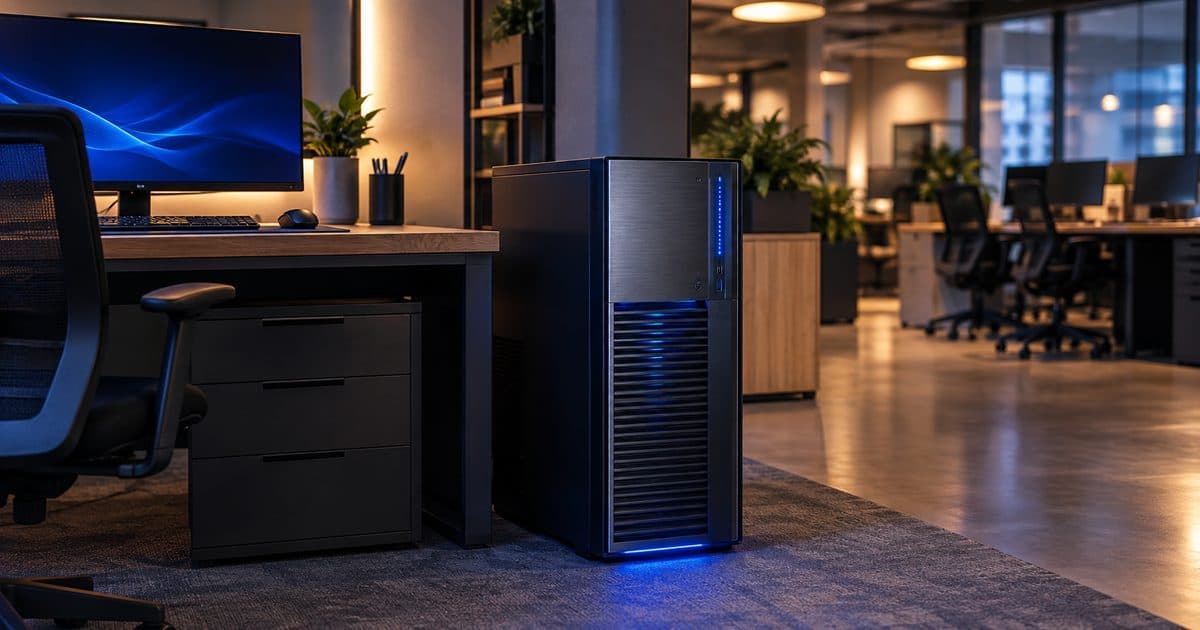
Where to Physically Place a Server in a Small Office — Noise, Cooling & Space Guide
Quick answer: a server needs clear airflow space on both its intake and exhaust sides, a stable temperature roughly between 18-27°C, protection from dust and moisture, and enough physical security that it can't be casually bumped, unplugged or opened. Most small offices don't have a purpose-built server room, so the real question isn't "where's the ideal spot" — it's which of the spots you actually have is the least bad, and what to fix once you've picked one.
Why "Just Put It in a Cupboard" Usually Goes Wrong
A server generates continuous heat as long as it's powered on, and it's designed to move that heat out through an intake-to-exhaust airflow path — pull cool air in one side, push hot air out the other. A closed cupboard, a cabinet with the doors shut, or a server wedged into a tight alcove interrupts that path: the same hot exhaust air gets pulled straight back into the intake, and the internal temperature climbs until the server's own fans ramp up to compensate, or the system throttles performance, or in a genuinely enclosed space, shuts itself down to protect the hardware. None of this is a hardware defect — it's the airflow design working exactly as intended, just fighting an enclosure it was never meant to sit in.
Airflow Clearance — The One Rule Everyone Skips
Leave real, open space in front of and behind the chassis — most tower servers need a few inches of clearance on each side at minimum, more if the space is otherwise enclosed. A server pushed flush against a wall, or backed directly into the closed door of a cabinet, has nowhere for that exhaust air to go. If you're placing it inside any kind of enclosure — a cupboard, a custom cabinet, an under-desk unit — cut or leave ventilation openings on at least two opposite sides so air can actually flow through, not just sit trapped inside.
Temperature, Humidity and Dust — What a Server Actually Needs
Most enterprise server hardware is rated to run across a fairly wide range, but the ideal operating band most manufacturers and industry guidance converge on is roughly 18-27°C (64-80°F) — comfortably within normal office air-conditioning range, which is good news for a small setup. What actually causes problems is a space that regularly drifts outside that band: an unventilated store room that traps daytime heat, or a spot near a window with direct sun exposure. Relative humidity in the general 40-60% range is the usual safe zone — too dry increases static risk, too humid risks condensation inside the chassis. Dust matters more in an office than most people expect: general office spaces, especially ones with carpet and regular foot traffic, generate far more airborne dust than a dedicated server room, so wherever you place it, plan to actually check and clean intake filters and fan grilles periodically rather than assuming it's a set-and-forget appliance.
Tower vs Rack: Which Fits a No-Server-Room Office Better
This is one of the more overlooked reasons the choice between a tower server and a rack server matters for a small office specifically. A tower server is built like a large desktop tower, standing on its own, with larger and slower-spinning fans — it's genuinely a better physical fit for an office corner, a cupboard, or a spot under a desk. A rack server is built to be one unit among many in a ventilated rack with structured front-to-back airflow across the whole row; taken out of that context and placed alone in a closet, its smaller, faster fans have to work harder and run louder to move the same amount of air, with nowhere for the heat to properly escape. If you don't have rack infrastructure, a tower-format server is almost always the more practical choice for this exact situation, not just a budget one.
Noise: What Actually Makes a Server Loud (and What Doesn't)
Fan noise scales with how hard the server has to work to move air — a server placed with good clearance in a reasonably cool spot runs its fans at a lower, quieter speed most of the time. The same server crammed into a warm, poorly ventilated space runs hotter internally, which pushes fan speed up and makes it noticeably louder — so a lot of "this server is too loud for the office" complaints are actually a placement and airflow problem, not a hardware problem. Rack-format servers are inherently louder under equivalent load for the reason above (smaller, faster fans), which is the other half of why format choice affects the real day-to-day experience of having a server in an occupied space.
A Few Non-Negotiables: Power, Security and Fire Safety
Whatever spot you choose, plan for a dedicated, reasonably clean power circuit and pair it with a properly sized UPS — a server that loses power ungracefully risks data corruption, not just downtime. Keep it somewhere it can't be casually bumped, tripped over, or unplugged by someone reaching for a different socket, and where the room isn't shared as general storage for boxes or paper stacked against the chassis, which blocks airflow and adds a real fire-load risk around live electrical equipment. A simple locking cabinet or a room that isn't freely walk-in accessible is enough for most small offices — you don't need a data center-grade access system, just enough friction that it isn't casually accessible to everyone in the building.
When You've Outgrown "The Cupboard"
Once you're running more than a server or two, adding networking equipment and storage, or find yourself actively fighting heat and noise no matter where you put things, that's usually the sign it's time to plan a proper, purpose-built space rather than keep optimizing around an office corner. Our guide on setting up a small data center covers rack space, dedicated cooling and power planning for that next stage.
Frequently Asked Questions
Can I keep a server in a closed cupboard or cabinet?
Only if it has real ventilation openings on at least two sides so air can flow through — a fully sealed cupboard traps the server's own exhaust heat and recirculates it back into the intake, which drives up internal temperature and can trigger thermal throttling or shutdown. If you must use an enclosure, cut or leave clearance for airflow rather than sealing it in.
What temperature is safe for a server in a normal office?
Roughly 18-27°C (64-80°F) is the commonly recommended operating band for most enterprise server hardware, which is well within normal office air-conditioning range. The bigger risk is a spot that drifts outside that range — an unventilated store room that traps heat, or direct sun exposure through a window.
Is a tower server quieter than a rack server for office use?
Generally yes. Tower servers use larger, slower-spinning fans similar to a desktop PC, while rack servers use smaller, faster fans designed for a ventilated rack environment — taken out of a rack and placed alone in an office, they typically run louder for the same workload. For a space without rack infrastructure, a tower-format server is usually the more practical and quieter choice.
How much clearance space does a server actually need?
As a practical minimum, leave a few inches of genuinely open space in front of and behind the chassis so intake and exhaust airflow isn't blocked. A server pushed flush against a wall or the closed back of a cabinet has nowhere for its hot exhaust air to go, which is one of the most common causes of overheating in ad hoc office placements.
When should I move from an office corner to a proper server room?
Once you're running more than a server or two, adding networking and storage equipment, or find yourself repeatedly fighting heat and noise no matter where you place things, it's usually time to plan a dedicated space with proper cooling, power and rack infrastructure rather than keep optimizing around office placement.
Get Placement and Sizing Advice for Your Setup
If you're not sure whether your space will actually work, or which server format fits it best, call or WhatsApp +91-87968-22044 and we'll help you think through it — including AMC coverage options once it's up and running, and our refurbished server range if a tower-format machine is the better fit for your space.