
Rack Server vs Tower Server: Which One Should You Choose for Your Data Center or Server Room?
If you're setting up IT infrastructure for the first time or scaling past your first server, this is usually the first hardware decision you hit: rack server vs tower server. The short answer — a tower server suits a small office with no dedicated server room and 1-3 servers; a rack server is the right call the moment you have a server room, plan to run more than 2-3 servers, or need proper cable management and cooling. The real decision depends on your room, your headcount, and where your business will be in 12-18 months, not just today's server count.
What's the Difference Between a Rack Server and a Tower Server?
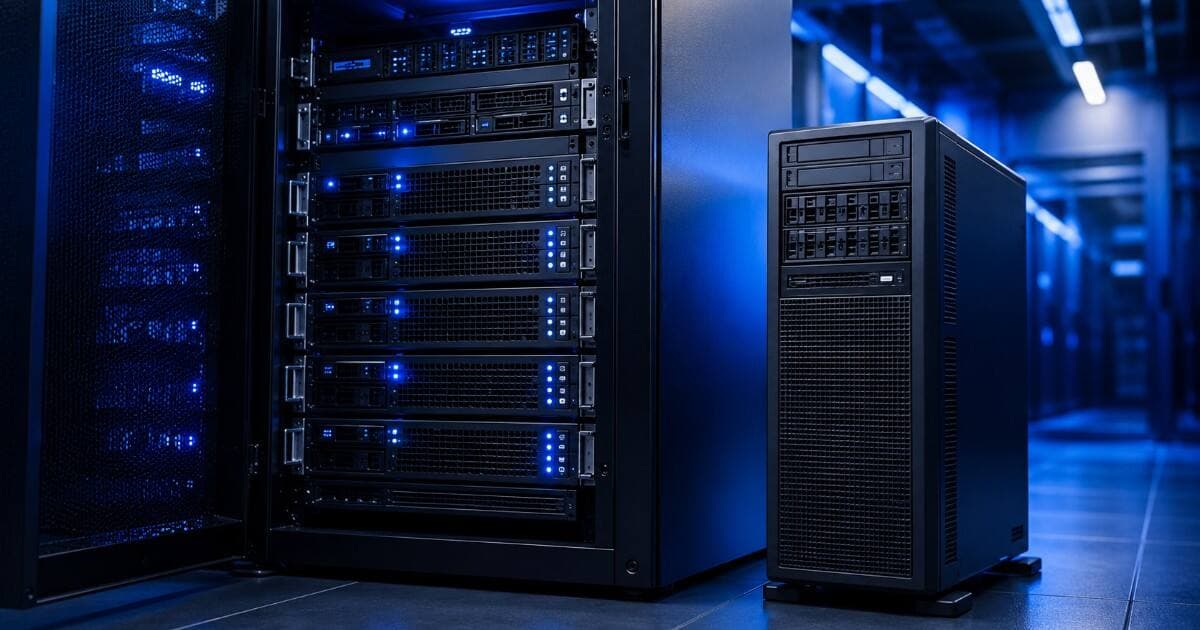
A tower server looks and stands like a large desktop PC/CPU cabinet — it sits on the floor or a table, has its own case, and needs no special furniture. A rack server is a flat, horizontal chassis (measured in "U" — 1U, 2U, 4U) designed to slide into a standard 19-inch server rack cabinet alongside other rack-mounted equipment like switches, firewalls, and PDUs.
The form factor decides almost everything else — cooling, noise, cable management, scalability, and how the room around the server needs to be built. That's why this is really a "how do you plan to run your IT room" question dressed up as a hardware question.
Rack Server vs Tower Server — Quick Comparison Table
| Factor | Tower Server | Rack Server |
|---|---|---|
| Form factor | Free-standing, PC-cabinet style | 1U/2U/4U, mounts in a 19" rack |
| Space needed | Floor/desk space, no rack required | Rack cabinet (6U-42U) + dedicated room ideal |
| Cooling | Standard split AC is usually enough | Needs consistent, front-to-back airflow; precision cooling above 4-5 servers |
| Noise | Quieter — fine for an office corner | Loud — high-RPM fans, not office-floor friendly |
| Scalability | Hard to add more than 1-2 units neatly | Built to stack — add servers, switches, storage in the same rack |
| Cable management | Basic, manual | Structured with rack cable arms/trays |
| Typical use | File server, AD/DC, small ERP, backup for <20 users | Virtualization, multi-server data rooms, colocation, hosting |
| Example refurbished models | Dell PowerEdge T340/T140, HPE ProLiant ML350 | Dell PowerEdge R430/R630/R740, HPE DL360/DL380 |
| Indicative refurbished price (India) | ₹35,000 – ₹1,20,000 | ₹45,000 – ₹2,50,000+ depending on config |
When Should You Choose a Tower Server?
A tower server is the right call when:
- You have 1-15 employees and need a basic file server, Active Directory/domain controller, or a lightweight accounting/ERP install.
- There's no dedicated server room — the server will sit in a cabin or a corner of the office, and noise/appearance matters.
- You're running 1-2 servers total and don't expect to add more in the near future.
- Budget is tight and you want the lowest entry cost — refurbished tower servers are the cheapest way into proper enterprise-grade hardware (ECC RAM, RAID, redundant power on higher models) instead of a repurposed desktop.
A refurbished Dell PowerEdge T340 or HPE ProLiant ML350 with a Xeon E-2200 series CPU, 32-64GB RAM, and RAID 1/5 storage comfortably runs a 10-30 seat office's file sharing, backup, and directory services.
When Should You Choose a Rack Server?
Move to rack servers when:
- You're setting up a dedicated server room or a small data center — see our small data center setup guide if you're starting from a bare room.
- You need to run 3 or more servers, or plan to within the next year — racks are built to scale, towers are not.
- You're running virtualization (VMware/Proxmox/Hyper-V) with multiple VMs and need dense, high-core-count compute.
- You want colocation-ready infrastructure — colocation facilities only accept rack-mount equipment, not towers. If you're weighing that path, our colocation vs own data center guide covers the full decision.
- You need proper structured cabling alongside switches, firewalls, and patch panels in one cabinet.
A refurbished Dell PowerEdge R630/R740 or HPE ProLiant DL380 Gen9/Gen10 with dual Intel Xeon processors, 128-256GB RAM, and hardware RAID handles 10-40 VMs or a full BPO/call center floor without breaking a sweat.
Real Buyer Scenarios
These are the actual questions we get on calls — matched to the right form factor:
- "I have 8 employees and just need shared files + backup" → Tower server (1U rack is overkill and needs a cabinet you don't have yet).
- "I'm setting up a 50-seat BPO floor" → Rack servers, minimum 2 (one for dialer/CRM, one for domain/backup) — check our call center server setup guide for exact sizing.
- "We're moving from a cabin to a real server room next quarter" → Buy rack now, even if you only need one server today — buying a tower and re-buying a rack server in 6 months costs more than starting right.
- "I want it quiet, it'll sit next to my desk" → Tower server, always — no rack server is quiet enough for an open office.
- "We're planning colocation in 6-12 months" → Rack server from day one; towers can't be colocated.
Does It Make Sense to Mix Both in One Setup?
Yes, and many growing businesses do exactly this: a rack-mounted primary/application server plus a tower as a secondary backup unit kept outside the server room (for basic disaster-recovery separation). Some tower servers also ship in a "convertible" chassis that can be rack-mounted with a kit, but this is the exception, not the rule — most towers stay towers. If you expect to scale past 2-3 servers within a year, it's cheaper to start on rack and add a proper rack cabinet (a 12U or 24U is enough for most SMBs — see server rack cabinet sizing) than to migrate later.
Why Refurbished Makes This Decision Easier
New rack servers carry a real cost premium that makes businesses default to towers even when a rack server is the better technical fit. Refurbished enterprise rack servers — tested, RAID-configured, with fresh drives and a warranty — cost 40-60% less than new, which means the "right" form factor for your setup is affordable even for a first-time data room. Every server we sell goes through testing and ships with a warranty plus optional server AMC for ongoing support, so refurbished doesn't mean unsupported.
Frequently Asked Questions
Is a rack server more expensive than a tower server?
For the same specs, rack servers are usually 10-20% costlier than towers because of the chassis engineering (rail kits, hot-swap bays, tighter cooling design). But refurbished rack servers often come in cheaper than a comparable new tower, so budget shouldn't be the only factor.
Can a tower server be mounted in a rack later?
Only if it's a "convertible" model sold with a rack conversion kit — most standard towers cannot be retrofitted. If there's any chance you'll need a rack setup within a year, buy rack-mount hardware from the start.
Which is better for VMware or Proxmox virtualization?
Rack servers, almost always. They offer higher core counts, more RAM slots, and better airflow for sustained 24/7 load — exactly what a hypervisor running multiple VMs needs.
Do I need a rack cabinet if I buy just one rack server?
Yes — a rack server physically needs a 19-inch rack cabinet or open-frame rack to sit in; it can't be placed on a desk or floor like a tower. Even a single 1U server needs at minimum a small 6U-12U cabinet.
Which is quieter, rack or tower?
Tower, by a wide margin. Rack servers use small, high-RPM fans for dense cooling, which makes them noticeably loud — they belong in a server room, not next to a workstation.
What's the minimum rack size I should start with for a small office?
A 12U or 24U rack cabinet comfortably fits 2-3 servers, a switch, a firewall, and a UPS with room to grow — most SMBs never need to go beyond 24U.
Talk to Serverwale Before You Buy
Tell us your headcount, workload, and whether you already have a server room, and we'll recommend the right form factor — tower or rack — along with exact specs, not just a product listing. Browse our tower servers range or call/WhatsApp us directly.
Serverwale — Burari, Delhi 110084
Call: +91-87968-22044 | WhatsApp: wa.me/918796822044