
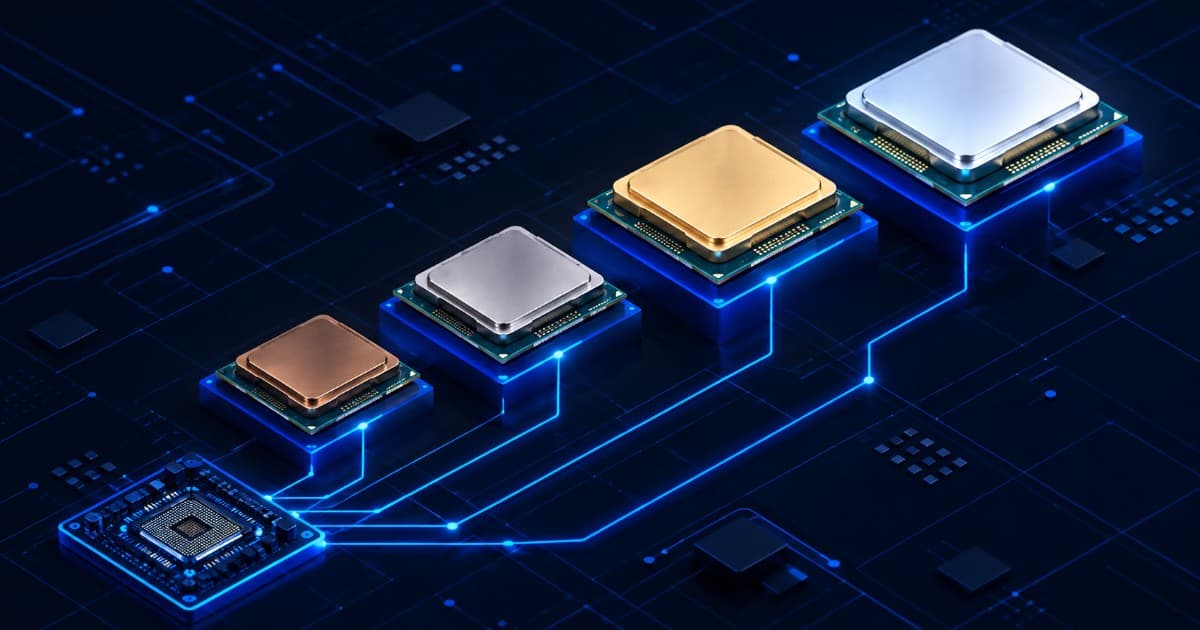
Xeon Bronze, Silver, Gold or Platinum? Scalable Tiers, Suffixes and Real Price Gaps
Short answer: the tier tells you how far a Xeon Scalable chip scales, not simply how good it is. Bronze and Silver are two-socket chips for lighter work, Gold is the usual choice for virtualisation and business servers, and Platinum adds the highest core counts and, in the first generation, eight-socket scaling. The model number carries the tier and the generation, and a letter suffix marks a special version. This guide decodes all three and compares starting prices for Indian buyers.
Key takeaways
- In a four-digit model such as 6148, the first digit is the tier (8 Platinum, 6 or 5 Gold, 4 Silver, 3 Bronze) and the second digit is the generation.
- First-generation Bronze has no Hyper-Threading or Turbo Boost. Silver and Bronze support two sockets, Gold four and Platinum eight.
- Price does not follow tier strictly. On our price page the starting price of a Platinum 8260 (₹48,000) is below a Gold 6248R (₹55,000), so compare exact models and cost per core.
- First and second-generation chips use the LGA 3647 socket and third-generation Ice Lake uses LGA 4189, so generations do not mix.
- Prices on this page are indicative starting prices read on 23 October 2026, not a quote.
This guide is for IT managers, sysadmins and buyers in India who are comparing refurbished servers and need to read a Xeon model number before paying for it. For a view across older families such as the E5-2600, read our Xeon generations buying guide. For prices on the processors themselves, see our Intel Xeon processor price page.
How to read a Xeon Scalable model number
Intel introduced the Xeon Scalable brand in 2017 with the Skylake-based Platinum 8100 series, and arranged it into four tiers: Bronze, Silver, Gold and Platinum. Each model name packs three facts into four digits and a possible letter.
| Part of the model number | What it tells you | Example |
|---|---|---|
| 1st digit | Tier: 8 = Platinum, 6 or 5 = Gold, 4 = Silver, 3 = Bronze | 6148 is a Gold chip |
| 2nd digit | Generation: 1 = first generation (Skylake), 2 = second (Cascade Lake), 3 = third (Ice Lake and Cooper Lake), 4 = fourth (Sapphire Rapids) | 6148 is first generation; 8280 is second |
| Last two digits | The SKU. Within a tier and generation, a higher number is generally the better chip | 6148 (20 cores) sits above 6130 (16 cores) |
| Letter at the end | A feature variant. See the suffix table below | 6248R, 6130T, 8160M |
Two examples. A Xeon Gold 6148 is a Gold chip (6), first generation (1), SKU 48, with 20 cores. A Xeon Platinum 8280 is a Platinum chip (8), second generation (2), SKU 80, with 28 cores. The second digit matters when you shop for a used server, because it tells you which platform generation the chip belongs to.
What each tier gives you: first generation
The first-generation range (Skylake-SP, 2017) shows the tier logic most clearly. The table below uses the published specifications for each tier.
| First-generation tier (Skylake-SP, 2017) | Sockets | UPI links | Memory speed | Hyper-Threading and Turbo | AVX-512 units per core | Example (cores / threads) |
|---|---|---|---|---|---|---|
| Bronze 31xx | Up to 2 | 2 at 9.6 GT/s | DDR4-2133 | Neither | 1 | Bronze 3106: 8 / 8, 1.7 GHz |
| Silver 41xx | Up to 2 | 2 at 9.6 GT/s | DDR4-2400 | Yes | 1 | Silver 4110: 8 / 16; Silver 4116: 12 / 24 |
| Gold 51xx | Up to 4 | 2 at 10.4 GT/s | DDR4-2400 (5122: 2666) | Yes | 1 (5122: 2) | Gold 5118: 12 / 24, 2.3 GHz |
| Gold 61xx | Up to 4 | 3 at 10.4 GT/s | DDR4-2666 | Yes | 2 | Gold 6130: 16 / 32; Gold 6148: 20 / 40 |
| Platinum 81xx | Up to 8 | 3 at 10.4 GT/s | DDR4-2666 | Yes | 2 | Platinum 8160: 24 / 48; Platinum 8176: 28 / 56 |
Three things stand out. First, Bronze is a different class: no Hyper-Threading and no Turbo Boost, with the slowest memory. It suits a basic file or print server and little else. Second, the number of sockets is a hard limit set by the tier, so a Silver chip cannot be used in a four-socket server. Third, Gold 61xx and Platinum look alike on paper, with the same memory speed, three UPI links and two AVX-512 units per core. The difference is socket scaling (four against eight) and the top of the core-count range. All first-generation Scalable chips have six memory channels.
Second generation and newer: what changed
The second generation (Cascade Lake, 2019) kept the same LGA 3647 socket and tier names, raised memory speeds and added refreshed R models in February 2020.
| Tier (second generation, Cascade Lake, 2019 to 2020) | Memory | What changed |
|---|---|---|
| Bronze 32xx | 6 channels of DDR4-2133 | Still no Turbo Boost. Bronze 3204: 6 cores, 6 threads. Bronze 3206R: 8 cores, 8 threads, 1.9 GHz |
| Silver 42xx | 6 channels of DDR4-2400 | Same memory speed as the first-generation Silver |
| Gold 52xx | Mostly DDR4-2666 | Gold 5218: 16 cores. Memory speed is higher than first-generation Gold 51xx |
| Gold 62xx | Mostly DDR4-2933 | Gold 6248: 20 cores, 3 UPI links. The refreshed Gold 6248R: 24 cores at 3.0 GHz, 2 UPI links, announced February 2020 |
| Platinum 82xx | 6 channels of DDR4-2933 | Platinum 8280: 28 cores, 56 threads, 2.7 GHz, 3 UPI links |
The third generation moved to a new socket and platform. Ice Lake-SP chips use LGA 4189 with eight channels of DDR4-3200, and the Platinum 8380 reaches 40 cores and 80 threads. The fourth generation (Sapphire Rapids, 2023) moved to eight channels of DDR5 up to 4800. In April 2024 Intel announced that the Xeon Scalable brand would be retired from the sixth generation, which is now sold simply as “Xeon 6”. Most refurbished Scalable stock in India today is first and second generation, which is what the rest of this guide focuses on.
Xeon suffixes: what the letter at the end means
A letter after the number marks a special version of the chip. Suffix meanings differ slightly between generations, so check the generation first.
| Suffix | Meaning (1st and 2nd generation) | Meaning (3rd generation) |
|---|---|---|
| F | Integrated Omni-Path fabric | Not used |
| L | Large memory tier, up to 4.5 TB per processor | HL: four-socket capable, up to 4.5 TB per processor |
| M | Medium memory tier, up to 1.5 TB (1st gen) or 2 TB (2nd gen) per processor | Media processing optimised |
| N | Optimised for network function virtualisation | Same |
| P | Not used | High-frequency version for infrastructure-as-a-service |
| S | Search optimised | Large 512 GB SGX enclave size |
| T | High case temperature, extended reliability | High case temperature |
| U | Single socket | Single socket |
| V | VM density optimised | High density, low power, for SaaS virtualisation |
| Y | Speed Select: different core counts with matching core speeds | Speed Select |
| H | Not used | Four-socket capable, up to 1.125 TB per processor |
| R | Not a feature: marks a refreshed second-generation chip (February 2020) | Not used |
For a typical buyer, the suffixes that matter are M and L (they raise the maximum memory per processor, which only matters for very large memory configurations), T (built for higher temperatures and a longer life) and U (single socket only, so it cannot be used in a dual-socket board). An F chip carries an Omni-Path fabric connector that needs a matching board, so it is not a drop-in swap for a plain chip. The R is easy to misread as a feature, but it only marks a refreshed second-generation model. Lenovo's reference also notes that 5218 and 5218B chips use different dies, and they should not be installed in the same server.
Real price gaps: what refurbished Xeon chips cost in India
Our Xeon price page lists indicative starting prices for refurbished, tested processors. We read it on 23 October 2026. The last column is simple arithmetic: starting price divided by cores, for one processor.
| Processor | Cores / threads | Base clock | Starting price on our price page | Starting price per core (arithmetic) |
|---|---|---|---|---|
| Xeon E5-2680 v4 (for reference) | 14 / 28 | 2.4 GHz | From ₹9,500 | about ₹679 |
| Xeon Gold 5118 | 12 / 24 | 2.3 GHz | From ₹11,000 | about ₹917 |
| Xeon Gold 6130 | 16 / 32 | 2.1 GHz | From ₹16,000 | ₹1,000 |
| Xeon Gold 6148 | 20 / 40 | 2.4 GHz | From ₹28,000 | ₹1,400 |
| Xeon Platinum 8260 | 24 / 48 | 2.4 GHz | From ₹48,000 | ₹2,000 |
| Xeon Gold 6248R | 24 / 48 | 3.0 GHz | From ₹55,000 | about ₹2,292 |
| Xeon Platinum 8280 | 28 / 56 | 2.7 GHz | From ₹95,000 | about ₹3,393 |
The pattern is clear. Cost per core climbs from about ₹679 for the E5-2680 v4 to about ₹3,393 for the Platinum 8280. Tier name alone is a poor guide though: the Platinum 8260 starts below the Gold 6248R. Price follows stock and demand as well as specifications, and it depends on the exact model and the quantity, so use the table to compare options, not to budget. These are starting prices, and a quote may differ. See the refurbished server price index for indicative whole-server ranges, and our Xeon price guide for older E5 families. Silver and Bronze chips are not on the price page, so ask us for current availability.
Which tier for which workload
| Your workload | Tier to look at first | Why |
|---|---|---|
| Virtualisation host (VMware, Proxmox, Hyper-V) | Gold, such as 5118, 6130 or 6148 | More cores and threads per socket and faster memory. Avoid Bronze: it has no Hyper-Threading |
| File, backup or print server | Silver, or an entry Gold 51xx | These jobs rarely need many cores, so a lower-cost tier is enough |
| Database or ERP with per-core software licences | A Gold with fewer, faster cores | Licences are often counted per core, so core count changes the software bill. The Gold 6128 is a 6-core 3.4 GHz example |
| Many-core or HPC job, in-memory analytics | Gold 6248R or Platinum 82xx | The highest core counts and memory speeds. Check cost per core before you decide |
| Four- or eight-socket server | Gold or Platinum only | Bronze and Silver support two sockets at most |
| Small office, light application | Silver, or step down to E5-2600 v4 | Do not pay for core count you will not use |
If you cannot decide between Intel and AMD for the same job, our Xeon vs EPYC comparison covers it, and our AMD servers page lists the alternatives.
Check the platform before you buy a processor
- Socket. First and second-generation Scalable chips use LGA 3647. Third-generation Ice Lake uses LGA 4189. A chip from one will not fit a board for the other.
- Server compatibility list. Each server supports only the processors on its vendor's list, and an older BIOS may not recognise a newer chip. Confirm the exact model and BIOS version first. Servers such as the Dell PowerEdge R640 and R740 take Scalable chips, as we explain in our R740 vs R640 comparison.
- Memory. Scalable servers use DDR4 ECC memory in this generation range. See our DDR4 server RAM price list and DDR3 and DDR4 RAM guide.
- Matched pairs. In a dual-socket server, fit two identical processors. Do not mix models.
- Cover. Buy tested chips with a warranty and a GST invoice. Serverwale lists a 1-year warranty on refurbished processors, with extended cover as a paid option. See server AMC for ongoing support, and our Dell vs HP servers guide if you are choosing the platform as well.
Frequently asked questions
What is the difference between Xeon Gold and Xeon Silver?
In the first-generation Scalable range, Silver (41xx) and Bronze (31xx) support up to two sockets, while Gold supports up to four. Gold 61xx chips have three UPI links and DDR4-2666 memory, Gold 51xx and Silver have two links and DDR4-2400, and Gold 61xx and Platinum have two AVX-512 units per core against one on Gold 51xx and Silver. In practice Gold reaches higher core counts and faster memory, and Silver is the cheaper step for lighter loads such as file, backup and small application servers.
Is Xeon Platinum worth it?
Only if you need what it adds: eight-socket scaling in the first generation, the highest core counts, or the top memory and clock options. For a normal two-socket server, a Gold chip often does the job. Price does not follow tier strictly either: on our price page the starting price of a Platinum 8260 is lower than a Gold 6248R. Compare the exact models and the cost per core, not the tier name.
What does the N, P, T or Y suffix mean on a Xeon?
The suffix marks a special version. On first and second-generation chips, F is an integrated Omni-Path fabric, L and M are larger memory tiers, N is optimised for network function virtualisation, S for search, T for high case temperature and extended reliability, U is single-socket, V is optimised for VM density and Y is Speed Select. On third-generation chips, P is a high-frequency version for infrastructure-as-a-service, and H means four-socket capable. R is not a feature suffix: it marks the refreshed second-generation chips announced in February 2020.
Should I buy Xeon E5 v4 or Xeon Scalable?
E5-2600 v4 is the lower-cost entry. Scalable is the newer platform, with six memory channels and a longer support runway, and it costs more even refurbished. On our price page the E5-2680 v4 starts at about ₹679 per core, against about ₹917 per core for the cheapest Gold listed. Our Xeon generations guide covers the choice in more detail. Pick by workload and by how long you need the platform supported.
How much does an Intel Xeon Scalable processor cost in India?
Starting prices on our Xeon price page, read on 23 October 2026, run from about ₹11,000 for a Gold 5118 to about ₹95,000 for a Platinum 8280, per processor, tested and with GST invoice. They are indicative starting prices, and the actual price depends on stock, quantity and generation, so ask for a quote before you plan a budget.
Can I put any Xeon Scalable processor in any Scalable server?
No. First and second-generation Scalable chips use the LGA 3647 socket, while third-generation Ice Lake chips use LGA 4189, so they do not fit the same boards. Even within a socket, a server only supports the processors on its vendor's compatibility list, so check the exact model and BIOS version before you buy a processor on its own.
Not sure which Xeon your server needs?
Tell us your server model and workload, and we will suggest a tier and a tested configuration with a quote. Call or WhatsApp +91-87962-44410, or contact us. You can also browse refurbished servers in India or see current Intel Xeon processor prices.
Sources: Wikipedia, Skylake (microarchitecture) (Xeon Scalable first-generation tier specifications), Cascade Lake, Ice Lake and Xeon; Lenovo Press, Intel Xeon Scalable Processor Reference (suffix definitions). Specifications should be confirmed on Intel ARK for the exact model before purchase. Prices are indicative starting prices from the Serverwale Xeon price page, read on 23 October 2026, and are not a quote. Last verified 23 October 2026.