
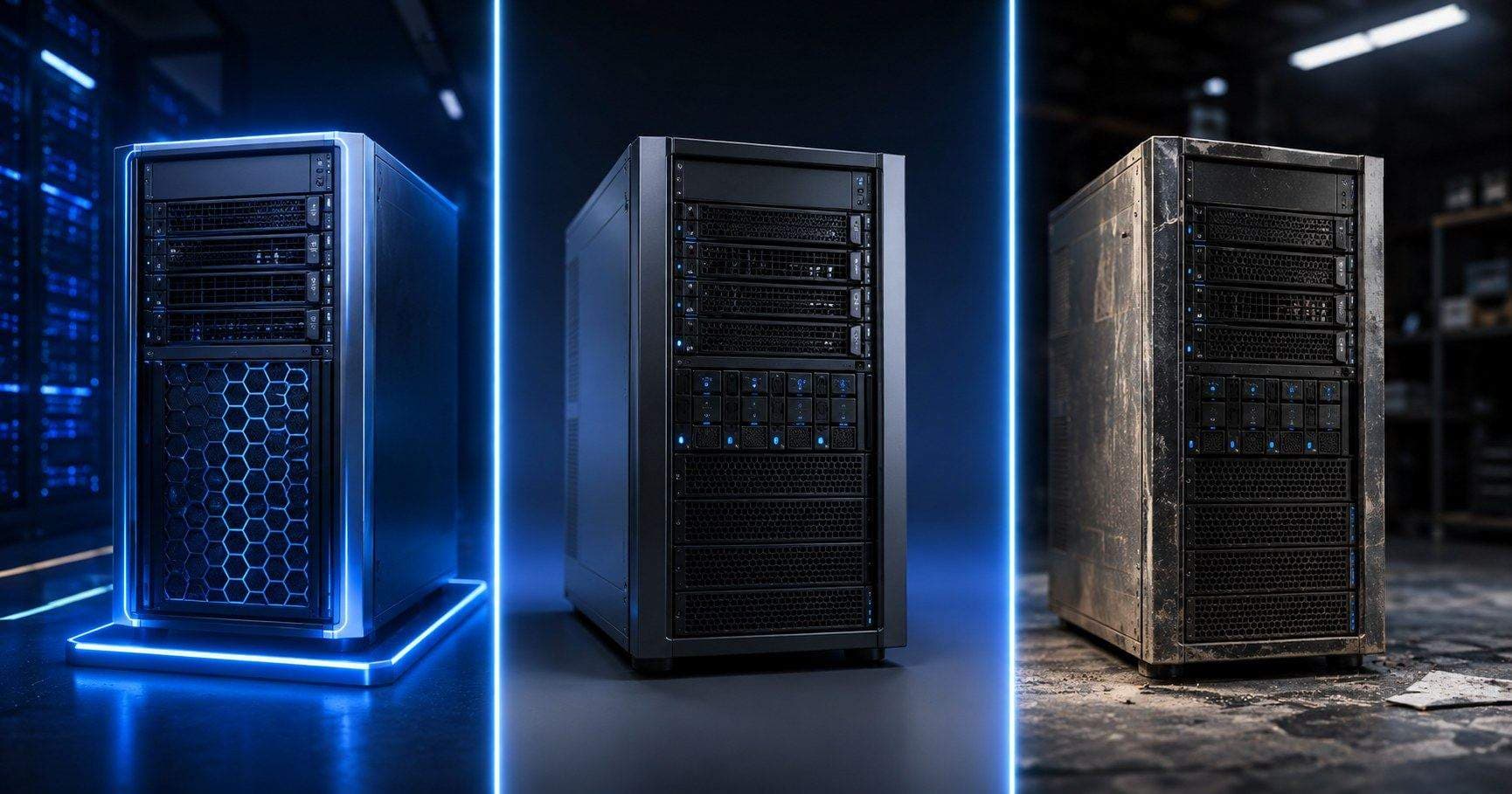
Refurbished vs Used vs Open-Box Server: What's Actually the Difference?
Quick answer: an open-box server was returned or unboxed but barely (or never) deployed — cosmetically new, no real usage history. A refurbished server has been used, then professionally tested component-by-component, repaired or upgraded where needed, and sold with a written warranty. A used server (sometimes called "as-is") has simply been pulled from service and resold with no standardized testing and usually no warranty. Same word "pre-owned" gets applied to all three by different sellers in India — the difference is entirely in what happened to the machine between its last deployment and your invoice.
Why This Confusion Actually Costs Buyers Money
In the Indian IT hardware market, "refurbished" isn't a legally defined or regulated term the way it can be in some other countries. A dealer selling an untested, wiped-and-relisted server is free to call it "refurbished" — the same word a dealer uses after running full diagnostics, replacing worn parts, and backing the unit with a 1-year warranty. Both listings can carry an identical price on paper. The only way to tell them apart is to ask what specifically was done to the unit, not to trust the label alone.
Open-Box: Minimal or No Prior Deployment
An open-box server is stock that was ordered, opened, and returned before serious use — a cancelled order, a wrong configuration, a display unit. It typically has near-zero power-on hours and looks cosmetically new, but it usually was never run through a full diagnostic cycle the way a properly refurbished unit is, because there's little to find. Open-box units sit closest to new-server pricing and carry the shortest supply in the market, since there simply aren't many of them.
Refurbished: Used, Then Tested, Repaired and Warrantied
A genuinely refurbished server has real deployment history — it ran in someone else's data center or server room for months or years. What makes it "refurbished" rather than just "used" is what happens next: every component (CPU, RAM, each drive, the RAID controller, both power supplies) gets tested individually, failing or worn parts get replaced, the drives get a certified data wipe, and the unit ships with a written warranty. Serverwale's own process, for example, is a documented 72-point test with a 72-hour burn-in before a server is listed as refurbished, backed by a 1-year warranty — that's the kind of specific, verifiable process that separates real refurbishment from a relabeled used unit. Data wiping follows the DoD 5220.22-M standard, with a destruction certificate available on request.
Used / As-Is: No Standardized Testing, No Guarantee
A used or "as-is" server has been pulled from active service and resold with no defined testing process. It may power on and work fine — plenty do — but there's no structured verification of drive health, RAID controller battery condition, or component wear, and typically no warranty beyond a short return window, if that. Used hardware is usually the cheapest option and can be a reasonable bet for genuinely non-critical, disposable use, but it puts the entire diagnostic burden on the buyer.
Side-by-Side: How the Three Actually Compare
| Aspect | Open-Box | Refurbished | Used / As-Is |
|---|---|---|---|
| Prior deployment | None or minimal | Real-world usage history | Real-world usage history |
| Testing before resale | Usually skipped (little to test) | Full component-level diagnostics | Little to none, seller-dependent |
| Data wipe | Not applicable | Certified (e.g., DoD 5220.22-M) | Varies, often unverified |
| Warranty | Often manufacturer's remaining warranty | Written warranty from the seller (commonly 1-3 years) | Rare, usually none |
| Price vs new | Closest to new pricing | Typically 40-80% below new | Lowest, but highest risk |
| Best for | Buyers who want near-new condition and don't mind a smaller model selection | Businesses that need tested, warrantied production hardware at a real discount | Non-critical, short-lived or disposable workloads only |
How to Tell Which One You're Actually Being Sold
Since sellers use these words loosely, ask three direct questions before you pay: what specific tests were run and can you see the report, what exactly does the warranty cover and for how long, and was the data wiped and can you get a certificate. A seller who answers all three with specifics is selling you a genuine refurbished unit regardless of what word is on the listing. A seller who can only say "it's tested" or "fully working" without detail is likely selling used stock under a refurbished label. For the complete pre-purchase due-diligence process, see the 10-point refurbished server buying checklist.
Frequently Asked Questions
Is a refurbished server as reliable as a new one?
A properly refurbished server — component-tested, burn-in verified, and warrantied — is a reliable choice for production workloads, and the core silicon (CPU, chassis, backplane) doesn't degrade with age the way consumer electronics can. The main differences from new are the length of warranty coverage and access to the very latest generation of hardware, not day-to-day reliability.
Does "open-box" mean the server is used?
Not meaningfully. Open-box stock has near-zero real deployment — it was returned, cancelled, or unboxed for display before serious use, so it's closer to new condition than to a genuinely used server, even though it isn't factory-sealed.
Why do two "refurbished" listings sometimes have very different prices?
Because the word isn't standardized, the cheaper listing is often an untested used unit relabeled as refurbished, while the higher-priced one reflects real diagnostic testing, replaced parts, and a written warranty. Ask what was actually done to the unit rather than comparing price alone.
Can a used server still be a good buy?
Yes, for non-critical or short-term workloads where downtime risk is low and cost matters most. For anything running production data or business-critical services, a tested and warrantied refurbished unit is the safer choice.
Should I ask for a data wipe certificate when buying refurbished?
You should ask that the previous owner's data was wiped, not that you personally need a certificate for a purchase — but a seller who can produce one (for example, to a DoD 5220.22-M standard) is demonstrating a genuinely documented process, which is a strong trust signal about how the rest of the unit was handled too.
Buy From a Seller Who Can Show, Not Just Tell
Serverwale sells genuinely refurbished Dell PowerEdge, HP ProLiant, Lenovo ThinkSystem and IBM System x servers — every unit is 72-point tested with a 72-hour burn-in, comes with a written warranty, and drives are wiped to the DoD 5220.22-M standard with a certificate on request. Check current refurbished server price ranges, browse the full refurbished servers catalogue, or ask about server AMC plans to keep it running. Call +91-87962-44410 or WhatsApp for a quote with your exact requirement.