
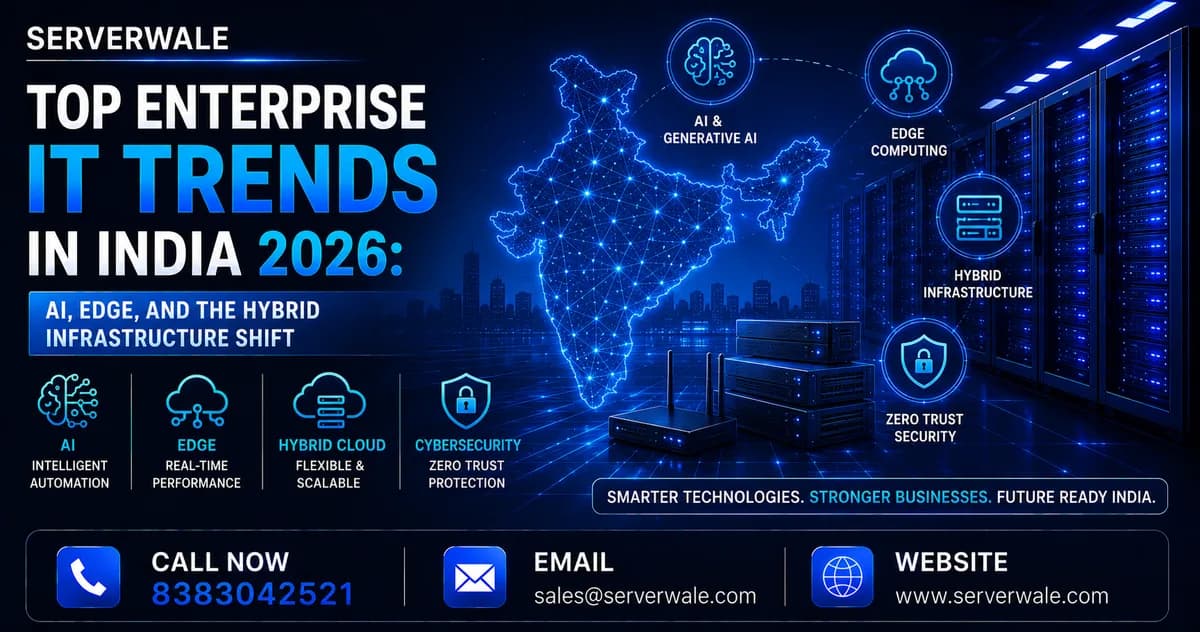
India's Enterprise IT Landscape in 2026
Indian enterprise IT is undergoing its most significant transformation in a decade. Simultaneously driven by AI adoption, regulatory pressure, and post-pandemic infrastructure rationalization, CIOs and CTOs are making investment decisions that will define their organisations' competitiveness for the next 5 years.
Trend 1: On-Premise AI Infrastructure
The most significant trend of 2025–2026: Indian enterprises are building private AI infrastructure at scale. Cloud GPU costs have made on-premise GPU servers economically compelling for consistent AI workloads. Companies are deploying:
- On-premise LLM inference servers for customer-facing AI assistants
- Private AI training clusters for proprietary model development
- GPU workstations for internal AI product teams
Vendors like Serverwale are seeing 3x growth in GPU infrastructure requests from Indian enterprises. The cost delta between cloud GPU and owned hardware makes the ROI undeniable for teams with predictable GPU requirements.
Trend 2: DPDP Act 2023 Compliance Driving Data Localisation
The Digital Personal Data Protection Act 2023 has moved from awareness to implementation in 2026. Key implications for enterprise IT:
- Personal data of Indian citizens must be processed in ways that enable government access — driving data residency in India
- Consent management systems required for all consumer-facing data collection
- Data fiduciary obligations driving investment in data governance infrastructure
- BFSI, healthcare, and edtech sectors facing strictest enforcement timelines
Infrastructure implication: Companies must be able to demonstrate where personal data lives and who can access it. On-premise or India-hosted infrastructure simplifies compliance vs. complex multi-cloud configurations.
Trend 3: The Hybrid Infrastructure Consolidation
Pure cloud is no longer the default for Indian enterprises. The 2026 model is hybrid:
- Public cloud for variable/burst workloads and global reach
- Private infrastructure (on-premise or colo) for predictable workloads and sensitive data
- Edge computing for latency-sensitive operations (retail, manufacturing, logistics)
The economic driver: optimising TCO. Moving predictable workloads to owned infrastructure while retaining cloud flexibility for variable demand.
Trend 4: Agentic AI in Enterprise Operations
Beyond generative AI assistants, Indian enterprises are deploying autonomous AI agents for IT operations (AIOps), customer support, procurement, and finance. Requirements:
- LLM inference infrastructure (low-latency, always-on)
- Integration with existing ERP and CRM systems
- Private deployment for confidentiality (not sending data to OpenAI)
Trend 5: FinOps — Engineering Teams Own Cost
Cloud cost management is being embedded into engineering culture. Indian tech companies are hiring FinOps specialists and deploying cost allocation tools. The realisation: without FinOps discipline, cloud bills grow 20–40% year-on-year unchecked.
What Indian CIOs Should Prioritise in 2026
- DPDP Act compliance audit and gap remediation
- AI infrastructure strategy (build vs buy vs cloud)
- Hybrid infrastructure cost optimisation
- Cybersecurity posture review (zero trust architecture)
- Legacy application modernisation